

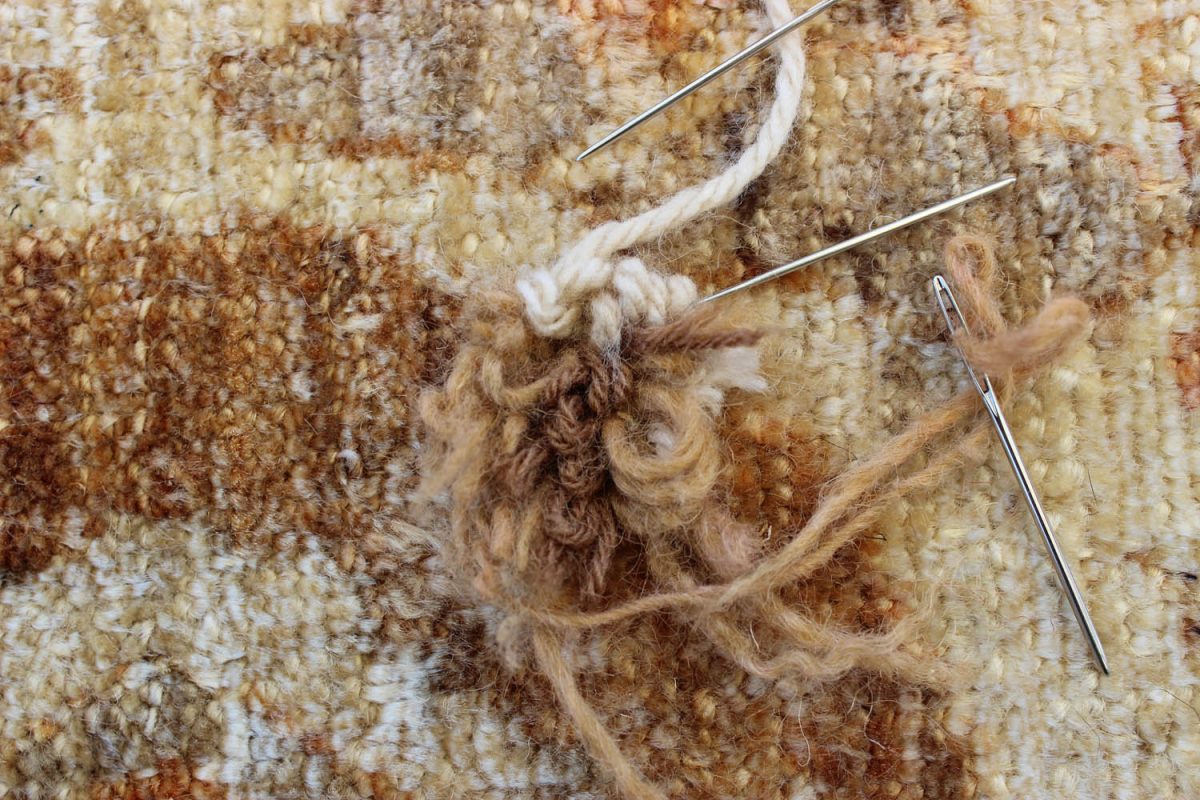
The five problems that come through our workshop most often are moth damage in wool, browning in viscose, returning pet odor, sun fading along windows, and worn edges and fringe. All five are common in San Diego, and all five are easier to fix caught early.
After washing and repairing rugs at one San Diego workshop across three generations, you start to see the same handful of problems again and again. They are not random. They come from how people here live, close to the coast, with big windows, pets, and a marine layer that keeps things damp. Knowing the five we see most often helps you catch yours early, while it is still a simple fix rather than a rebuild.
1. Moth damage in wool rugs
This is the one that surprises people most, because moths are silent and slow. Clothes moths lay eggs in wool rugs that sit undisturbed in humid, low-traffic rooms, and the larvae eat the fibers from the back of the rug where nothing shows. By the time a bare patch appears on top, a whole section of pile may already be gone. Our damp coastal air makes it worse, since moisture keeps rooms soft and inviting. The fix ranges from a wash that clears eggs and larvae to full moth damage repair if the pile is already eaten. Lifting a corner of any rug under a bed or heavy sofa a couple of times a year is the cheapest insurance there is.
2. Browning and stiffening in viscose rugs
Viscose and bamboo silk rugs are everywhere in San Diego remodels because they look like silk for less, but they are the most fragile fiber we handle. They lose strength when wet and brown easily when coastal damp wicks up through them or a drink gets spilled. We see viscose rugs that went stiff and discolored from nothing more than humidity in a beachside room. Caught early they can often be improved, but the honest truth is that viscose has limits, which is why our viscose rug cleaning page explains how gently these have to be handled.
3. Pet odor that keeps coming back
Every household with pets sees this eventually. An accident gets cleaned up on the surface, the smell seems gone, and then it returns on the first humid morning. The reason is that urine leaves salts deep in the foundation that draw moisture from the air. Surface cleaning never reaches them. The lasting fix is a wash with a urine decontamination treatment that dissolves those salts at the source, and it is one of the most common jobs we do.
4. Sun fading along windows and doors
San Diego sunshine is hard on rugs. A rug that sits in a band of afternoon light through a window or a sliding door will fade along that strip, sometimes badly enough that one side no longer matches the other. There is no undoing sun bleach, but it is easy to prevent by rotating the rug a couple of times a year so no single area takes all the light. If fading has already set in unevenly, a wash can even out the overall tone and a careful eye can advise on placement going forward.
5. Worn edges, unraveling fringe, and curling corners
The edges of a rug are its most exposed part, and they fail first. Fringe frays and pulls loose, side bindings wear through, and corners curl and get caught underfoot until they tear. These are foundation issues, and once the edge starts to unravel it runs like a dropped stitch, so a small fix left alone becomes a large one. Timely fringe repair and edge binding stop the unraveling before it reaches the body of the rug. This is the clearest case of all where early beats late.
The thread that connects all five
Look back at the list and a pattern shows: almost every one of these problems is moisture playing a different role.
The marine layer keeps coastal rooms damp enough for moths to thrive in undisturbed wool and for pet deposits to reannounce themselves each morning. Water is the trigger viscose cannot tolerate. Even sun fading has a moisture angle, since salt haze on the glass scatters light and dulls dye alongside the direct sun. San Diego reads as a dry place, and inland it mostly is, but the coastal strip where so many fine rugs live runs damp for months of the year in a way owners consistently underestimate.
That is worth knowing because it changes the inspection habit. The question is not only where does this rug get walked on, it is where does this rug stay damp. Under furniture near an ocean facing window is the riskiest square footage in the house, and it is precisely the spot nobody checks.
Prevention that actually works here
Each of the five has a countermeasure, and none of them is complicated.
- Moths: disturbance is the defense. Rotate rugs so no section sits under furniture for years, vacuum the areas that never see feet, and look at the back of stored or half hidden rugs a few times a year. Moths need peace to do damage, so deny them peace.
- Viscose: keep liquids away, full stop. No plant pots on the rug, no drink tables over it, dry methods only for home care. Treat a viscose rug like upholstery, since that is closer to what the fiber can survive.
- Pet odor: respond to accidents completely the first time. The half treated accident is the one that comes back every humid morning until it gets a real decontamination wash.
- Sun: rotate end for end twice a year so exposure evens out, and use the window coverings during peak afternoon hours in ocean facing rooms. Fading you spread evenly reads as mellowing; fading in one stripe reads as damage.
- Edges and fringe: vacuum with suction only and skip the fringe entirely, then fix small unraveling early. Every edge failure we rebuild started as a small one that would have been a minor binding job.
The five minute seasonal check
Twice a year, walk the house: press fingers into the base of each pile and feel for grit, fold the pile back and compare base color to tips, lift each rug’s corner and glance at the back, sniff on a marine layer morning, and run a hand along edges and fringe. Five minutes, no tools. It catches all five problems at the stage where they are small.
Fix now or live with it
Not everything the check finds demands action, and knowing the difference saves money in both directions.
Grit, returning odor, and any moth evidence are now problems. Each one is actively degrading the rug every week it waits, and the cost of addressing them only grows. Moth activity in particular deserves same week attention, since a colony that has found a wool rug does not stop on its own.
Even fading, mild edge wear on a sturdy rug, and the general patina of use are judgment calls. A hand knotted rug is allowed to look lived with, and some of what owners perceive as damage is just a rug aging honestly. Where the line falls depends on the rug’s quality and what it means to your family, which is exactly the conversation a free evaluation is for. We will tell you plainly which findings are urgent, which can wait, and which are character. After three generations of these conversations, we have gotten comfortable saying all three.
Two more we see, just less often
Beyond the big five, two other problems arrive at the workshop steadily enough to deserve a mention.
Water damage from plumbing rather than weather. Dishwasher lines, water heaters, and upstairs bathrooms put more San Diego rugs under water than rain does. The rug sits in the flood path, absorbs everything, and stays damp against the slab while the household deals with the larger emergency. Speed decides these cases, since browning, dye migration, and mildew all advance while the rug waits. Our water damage restoration page covers the first moves, and the short version is get the rug up, get air moving, and call the same week.
The slow motion version
Foundation rot in rugs that lived somewhere damp. A rug stored in a garage against a slab wall, or laid where a planter drained into it, can look fine from above while the cotton foundation loses its strength below. The test is a gentle flex of the back, listening for a dry crackle. Caught early, the affected area can be stabilized or rebuilt; discovered late, it becomes a conversation about what is worth saving. Storage habits prevent nearly all of it.
Both problems share the same lesson as the five above: the rug shows distress late, so the owner’s habits carry the defense. Nothing on this list is exotic, and nothing on it requires more from you than an occasional five minute check and a reasonable response time when something does go wrong. That is the whole discipline, and it is enough to keep a good rug in service for a very long time.
The rug you just acquired
New homeowners, renters furnishing a first place, and families inheriting pieces all end up with the same situation: a rug whose history is unknown. Estate rugs may carry years of the moth risk nobody checked. A rug bought secondhand may have an old pet spot waiting for the first humid week to introduce itself. Even a new purchase from a showroom has been rolled, shipped, and stored in ways you did not see.
An evaluation on arrival sets the baseline. You learn the fiber, the construction, any hidden damage, and whether the rug should be washed before it joins the household. It costs nothing, and it converts an unknown object into one you know how to care for. For inherited pieces especially, it answers the question families actually have, which is whether the rug that mattered to someone is sound enough to keep mattering.
Timing the evaluation is easy to get right. Before the rug goes under furniture is ideal, since whatever it carries is easiest to address while the piece is still out in the open. If it has already been down for a while, the next furniture rearrangement or carpet-free deep clean of the room is the natural moment. The point is simply that the unknown period ends somewhere, on purpose, rather than whenever the rug finally forces the issue.
Common questions
A few times a year, lift a corner of any rug that sits under a bed or a heavy sofa and look at the back for loose fiber, sandy webbing, or thin patches. Moths work from the underside in still, humid rooms, so those are the rugs to watch.
Viscose is a plant fiber that browns when it stays damp, whether from coastal humidity, a spill, or an in-home cleaning that left it wet. It is the most delicate rug fiber and needs the gentlest handling, which is why the browning is so common near the coast.
No, sun bleaching is permanent, but it is preventable. Rotate a rug a couple of times a year so no one strip takes all the afternoon light. A wash can even out the overall tone, but it cannot restore color the sun has removed.
Yes, and sooner is far better. An unraveling edge runs like a dropped stitch and spreads into the body of the rug if ignored. Caught early it is a small binding or fringe repair rather than a major reweave.
Because the salts urine leaves in the foundation pull moisture from humid air and reactivate the smell. Surface cleaning cannot reach them. A full wash with a decontamination treatment is what finally clears it.
If you recognize any of these in your own rug, catching it now is the difference between a wash and a rebuild. Request a free estimate and we will tell you honestly what it needs, with pickup and delivery across San Diego County.
