

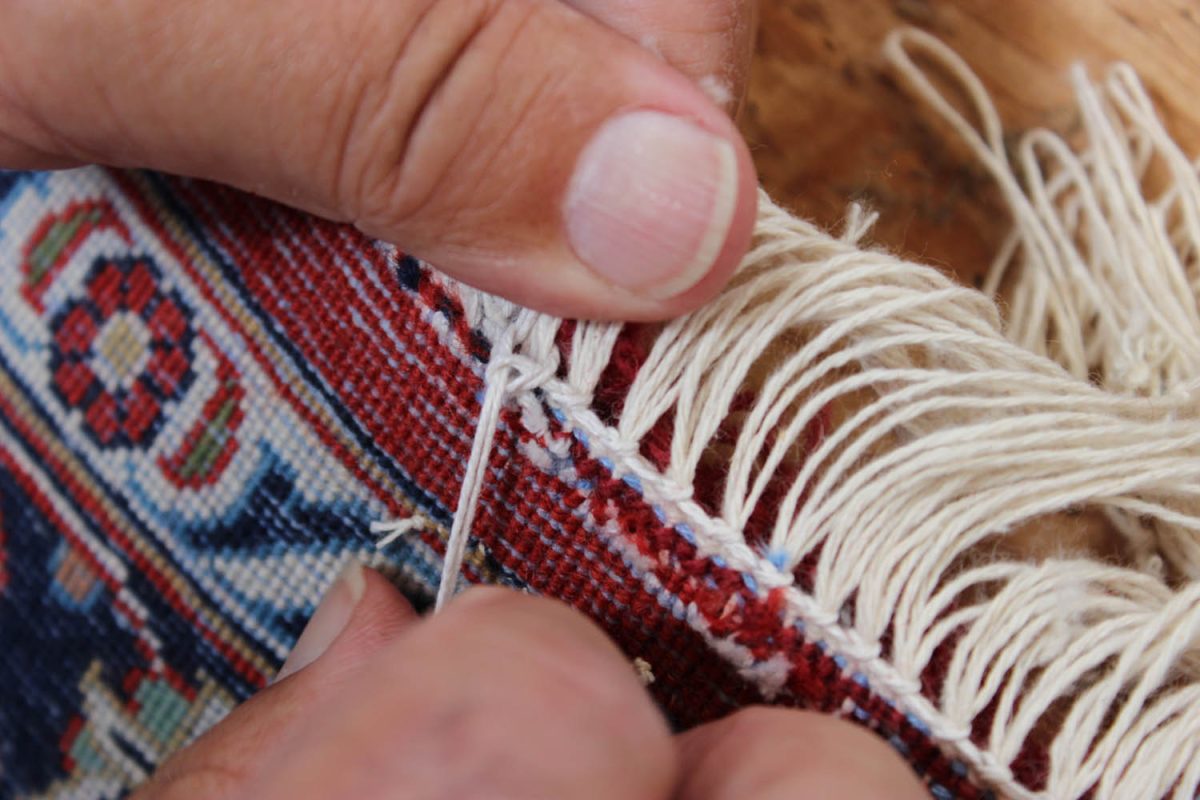
Rug repair is priced by the work the rug needs, not by a flat rate, because a small fringe fix and a full reweave are hours apart. The main factors are the type of repair, how much of the rug is affected, the fiber, and whether the foundation itself needs rebuilding. The evaluation is free.
Repair is harder to price than cleaning, because no two damaged rugs are damaged the same way. A loose fringe on one rug and a moth-eaten hole in the middle of another are completely different amounts of hand work. Rather than quote a number nobody can honestly give sight unseen, this guide explains what actually drives the cost of a repair, so you know what you are looking at before you bring the rug in. Our family has repaired rugs by hand at our San Diego workshop since 1956, and the evaluation is always free.
Repair is hand work, and that is what you are paying for
Machine-made goods are cheap to replace and rarely worth repairing. A hand knotted rug is the opposite, because the repair is done by hand, knot by knot, matching the original wool, dye, and weave structure. That skilled time is the cost. It is also why a good repair is invisible and a bad one stands out, and why the price tracks the hours far more than the size of the rug. A small hole in a finely knotted silk rug can take longer than a larger fix in a coarse wool one.
The type of repair is the biggest factor
Different repairs are different amounts of work, from quickest to most involved:
- Fringe repair and securing resets or protects the ends, and is usually the lightest job. See our fringe repair page.
- Edge and side binding rebuilds a worn or unraveling side so it stops running.
- Reweaving and hole repair rebuilds missing pile and foundation, and is the most detailed hand work, covered on our hole repair and reweaving page.
- Full restoration combines several of these on an antique or badly damaged piece, and is quoted as a project. Our restoration page explains that work.
How much of the rug is affected
A single frayed corner is a contained job. Moth damage across several areas, or wear that runs the length of an edge, multiplies the hand work. The size of the affected area matters far more than the size of the rug itself. This is why catching damage early keeps the cost down. A corner caught before it unravels is a small repair. The same corner left for a year, once the unraveling has run into the body of the rug, is a much larger one.
Fiber and knot density
Matching the repair to the original means matching the fiber and the weave. A coarse, low-knot wool rug is quicker to rebuild than a finely knotted silk or high-density piece, where each square inch holds many more knots to replicate. Sourcing wool and dye that match the original also takes more effort on an antique or unusual rug. None of this is about the rug being large or small. It is about how fine and how particular the weave is.
Whether the foundation needs rebuilding
The most involved repairs are the ones where the foundation itself has failed. Dry rot, water damage, or old age can leave the cotton base brittle so it cracks instead of flexing, and you cannot rebuild the pile on a foundation that is falling apart. In those cases the foundation is rebuilt first, then the pile is reknotted above it, which is real restoration work. Whether it is worth doing depends entirely on the rug, and that is exactly the question a free evaluation answers.
Why the free evaluation is the honest answer
Because repair cost depends on all of these together, the only real number comes from looking at the rug. We unroll it, find every area that needs work, check the foundation, and write up what it would take, so you can decide what you want done. Some rugs are worth a full restoration and some are better simply cleaned and enjoyed as they are, and an honest shop will tell you which is which. There is no charge to find out.
The repairs we see most, and what drives each one
Four kinds of damage account for most of the repair bench, and each has its own labor logic.
Fringe work spans the widest range. Securing a fringe that has begun to unravel is quick, careful work at the ends of the foundation threads. Rebuilding a fringe that has worn away entirely means anchoring new foundation, and the difference between those two jobs is exactly why catching fringe damage early matters so much. The fringe is not decoration; it is the skeleton of the rug showing at the ends, and damage that reaches past it starts consuming pattern.
Edges, then the field itself
Edge and selvage work follows the same early versus late logic. Overcasting a worn edge before the wrap fails is routine. Rebuilding an edge after the outer warps have broken, with pile loss creeping inward, is reconstruction. Binding and serging caught early is among the most economical work we do relative to what it prevents.
Holes and moth damage are where labor climbs fastest, because reweaving rebuilds the rug itself. New warps and wefts are anchored into sound surrounding foundation, then pile is reknotted to match color, knot style, and density. A patch the size of a palm in a fine, dense weave holds an enormous number of individual knots, which is why the same size hole is a bigger job on a finer rug.
Why density multiplies everything
Knot density is the quiet multiplier behind every reweaving quote. Doubling the knots per square inch roughly doubles the hand work in the same physical area. It also raises the bar for matching, since fine weaves show imprecision that coarse village rugs forgive. This is not a reason to avoid repairing fine rugs. It is the reason fine rugs are the ones most worth repairing well.
Deciding whether a repair is worth it
The honest question is never only what the repair involves. It is what the rug means.
Market value gives one answer. A sound hand knotted rug with decades of life left usually justifies real repair, since the alternative is replacing something whose equal costs far more than fixing it. A worn machine made piece usually does not, and we say so rather than sell the work.
The value only your family can price
Sentimental value gives a different answer, and it is just as legitimate. A rug that came from a grandparent’s home is not a market decision, and plenty of the most careful work on our bench is done on rugs whose value is entirely in whose floor they used to lie on. What we owe you in that conversation is honesty about what the repair achieves: full structural restoration, or stabilization that stops the damage where it stands.
Stabilization deserves more attention than it gets. Not every rug needs invisible restoration. Securing damage so it cannot spread, at a fraction of the labor, is often the right call for a rug that is loved but not rare. The free evaluation is where we lay out both paths and let you choose.
How a repair moves through the workshop
Repair follows a fixed order, and the order itself protects the rug.
- Evaluation first. The damage is assessed from both faces of the rug, the foundation’s soundness is checked around it, and the written scope names what will be done.
- Materials are matched before work begins: wool for color and texture in daylight, cotton or wool foundation thread for gauge, dyes where custom matching is needed.
- Structural work proceeds from foundation outward. Warps and wefts before knots, knots before finishing, so each layer rests on a sound one.
- Washing usually follows repair, so the repaired area and the original pile settle together and the rug comes back as one piece rather than a rug with a new patch.
- Final inspection compares the repair against the surrounding weave in natural light before the rug is released.
The sequence is three generations old and it does not get rearranged for convenience. Rugs move through it at the pace the work demands, which is the only honest speed a hand repair has.
Old repairs: keep them, redo them, or leave them alone
Rugs with some age usually arrive carrying previous repairs, and evaluating those is part of the estimate too.
Some old repairs are simply good. A sound reweave from decades ago that has worn in with the rug around it is part of the piece’s history, and disturbing it would be work for work’s sake. We point these out and leave them be.
Telling the difference
Others are damage wearing a bandage. Crude patches sewn over holes, edges wrapped in the wrong material, glue where stitching belonged, and painted-in color hiding worn pile all show up regularly. Glue is the worst offender, since it stiffens the foundation, resists proper washing, and has to be carefully removed before honest repair can happen, which adds work the original shortcut created. When we find these, the estimate explains what the old fix concealed and what putting it right actually involves, and you decide whether now is the time.
The practical rule: a repair should either restore structure or honestly stabilize damage. Anything that merely hides a problem is borrowing against the rug’s future, and the loan comes due with interest.
How long repair work takes
Repair time scales with the same factors as repair cost, and for the same reason: it is hand work. A fringe securing or small edge job moves through the bench quickly. A reweave in a fine weave takes as long as rebuilding that many knots takes, and matching materials adds its own time when a wool color or foundation gauge has to be sourced rather than pulled from stock. When repair and washing are both needed, repair goes first, then the wash, so the finished work settles in with the rug as one piece.
What we commit to is the same as with pricing: the written scope includes the expected timeline, and if something inside the rug changes that timeline, you hear about it before the work continues. A rushed repair is a repair done twice, and the second time is never cheaper.
Common questions
Because repair cost depends on the type of damage, how much of the rug is affected, the fiber, and whether the foundation needs rebuilding, none of which can be judged without seeing the rug. A phone quote would be a guess. The in-person evaluation is free.
Often yes, for a hand knotted rug with sentimental or real value, since a good repair is invisible and extends the rug for generations. For an inexpensive machine-made rug it usually is not. The free evaluation tells you honestly which category yours is in.
Fringe work is usually the lightest, since it resets or secures the ends without rebuilding pile. Edge binding is next. Reweaving a hole and rebuilding a foundation are the most detailed and involved.
Less than people expect. What drives the cost is how much area is damaged and how fine the weave is, not the overall size. A small hole in a finely knotted rug can be more work than a larger fix in a coarse one.
Repairs are done first, then the rug is washed, so the finished piece comes back both rebuilt and clean. We handle both at the same workshop, so the rug only makes one trip.
The only accurate repair number is one made with your rug on the bench. Request a free evaluation and we will tell you exactly what it needs and whether it is worth doing, with pickup and delivery across San Diego County.
