

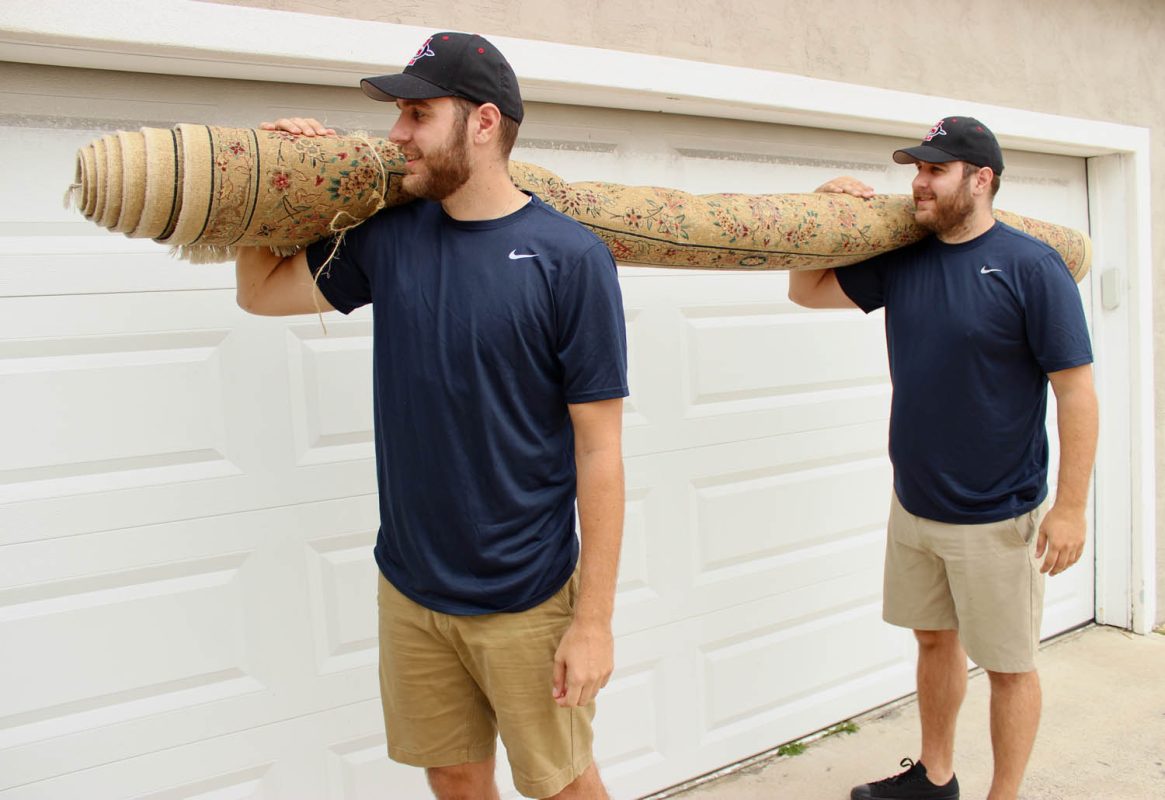
Store an area rug clean, rolled rather than folded, wrapped so it breathes, and up off the floor. Rugs that go into a closet or garage dirty come out with moth damage, mildew, or a crease that will not relax, and none of that was there going in.
Every summer a wave of rugs goes into storage across San Diego. A remodel starts, a floor gets refinished, a family moves between houses, or a wool rug simply comes up for the warm months. And every year some of those rugs come out of the closet or the garage with moth damage, mildew, or a crease that will not relax, none of which was there when the rug went in. We have unrolled enough of them at our workshop over three generations to know exactly where storage goes wrong. The good news is that storing a rug well is simple. It is the shortcuts that are expensive.
Clean it before you store it
This is the one non-negotiable, and it is the step people skip. Moths and carpet beetles are not drawn to wool itself so much as to what a used rug carries: skin cells, food traces, pet dander, spilled things long forgotten. The larvae eat the wool, but the soil is what invites the infestation. A rug that looks perfectly fine can hold enough nutrition to feed moths for months in a dark closet, and darkness plus stillness is exactly the environment they breed in. Washing the rug before it goes away removes the attraction, and it also means whatever spill is sitting unseen in the pile does not spend a year setting into a permanent stain. Our nine step immersion wash, the same process we have run since 1956, leaves the wool clean to the foundation, and details are on our rug washing page.
Moth season here never really ends
In cold climates, winter knocks the moth population back every year. San Diego’s mild coastal climate gives webbing and casemaking clothes moths something close to a year-round season, which is why our repair bench sees moth work in January as often as July. The eggs are nearly invisible, the larvae do the eating, and by the time you spot the papery casings or a bare patch of foundation, the colony has usually been working for months. Storage is where they do their best work because nothing disturbs them. Vacuum-sealed darkness with a food supply is a moth farm.
Roll, never fold
Folding puts hard creases in the foundation. Cotton warps and wefts that have held tension for decades do not appreciate being bent to a point, the crease can crack the foundation over time, and some never fully relax even after months back on the floor. Roll the rug instead, snug and even, with the pile facing inward to protect the surface. Roll in the direction of the pile so the fibers lie flat, which you can find by running your hand across the rug and feeling which way strokes smooth. For a fringed rug, tuck the fringe flat as you go so it does not tangle or crush. A rolled rug around a tube is even better if you have one, since it keeps the center from collapsing.
Wrap it so it can breathe
Plastic is the mistake here. A sealed plastic wrap traps whatever moisture is in the wool against the wool, and in a garage that cools and warms every day, condensation cycles inside the wrap until storage becomes a mildew chamber. Wrap the rolled rug in breathable material instead, cotton sheeting or Tyvek both work, keeping dust off while letting air move. Leave the ends loosely covered rather than taped airtight. Kraft paper is acceptable for shorter stretches, but skip newspaper, since the ink transfers.
Choose the spot like it matters, because it does
The two default storage spots in a San Diego house are the two worst ones. The garage sits on bare concrete that wicks ground moisture year round, and near the coast the marine layer keeps garage air damp through every May Gray and June Gloom morning. The attic swings hot enough in a Santa Ana week to dry wool and cotton brittle. A closet or any climate-steady interior space beats both by a wide margin. Wherever the rug lives, keep the roll up off concrete on a shelf, a pallet, or a pair of two-by-fours, and store it flat or standing upright where nothing will be stacked on top of it. A rug crushed under boxes for a year develops pressure marks that behave like creases.
How long can a rug safely stay stored?
Prepared properly, a wool rug can sit for years without harm, and we have unrolled pieces stored for a decade that came out exactly as they went in. The risk does not come from time itself. It comes from time multiplying whatever went in with the rug: a little soil becomes an infestation, a little dampness becomes mildew, a tight fold becomes a cracked foundation. If a rug is going away for more than a year, re-roll it once along the way so the tension redistributes, and treat that as your inspection date too. Rugs stored on their side should be stood on the opposite end at the same time so one edge does not carry the weight the whole while.
Check on it every couple of months
Set a reminder and actually look. Unwrap an end, check for casings, webbing, or a musty smell, run your hand over the exposed pile, and rewrap. Cedar blocks nearby are worth using, with the caveat every rug person will give you: cedar deters moths while its oils are fresh, and it stops working long before it stops smelling like a nice closet. Refresh or sand the blocks a couple of times a year. Mothballs work but the odor outlasts the storage by a long way, and most people regret them.
Do not store the pad with the rug
Rug pads age differently than rugs. The rubber and latex in most pads oxidize and get sticky or crumbly in storage, and a pad rolled up inside a rug can transfer that breakdown straight into the pile, leaving a gummy residue or a snowfall of dried latex crumbs through the wool. Roll the pad separately if it is worth keeping, and plan on replacing a cheap one rather than storing it. Coming out of storage is its own small ritual: unroll the rug and let it lie flat for a day or two before furniture goes on it, and if an edge wants to curl, roll that section gently the opposite way for an hour. Give it a gentle vacuum without the beater bar to lift the pile, and lay it over a fresh pad, not the one that spent a year fermenting in the garage.
Handle repairs before storage, not after
Small problems get bigger in the dark. A loose fringe keeps unraveling, a starting hole catches and grows, and early moth activity spreads unchecked. Have weak spots addressed by rug repair before the rug goes away so you are not unrolling a larger project later. And if you unroll a stored rug to find bare patches, exposed foundation, or sandy grit that looks like it fell from the pile, stop vacuuming and have it looked at. That is moth damage, it is very treatable, and our rug moth damage repair page shows what rewoven areas look like when they are done right.
Before your rug goes away
At Zeytounian Rugs we wash rugs so they store clean and pest-free, repair the weak edges storage tends to find, and we are happy to talk through where in your house a particular rug will store safely. Bring it by the Kearny Mesa shop, or schedule a pickup anywhere in San Diego County. The wash it gets before storage is the cheapest insurance a wool rug can buy.
What San Diego Storage Actually Does to a Rug
Storage damage in this county is rarely dramatic. It is slow, and it is almost always about moisture moving in and out of wool while nobody is watching. A garage in Clairemont or a closet in Chula Vista swings through a wide humidity range across a single day, and every one of those swings is absorbed by the fibers. Wool is hygroscopic: it takes on water from the air and gives it back, and it does that whether the rug is on a floor or rolled in a corner.
That matters because the damage thresholds are not obvious from the outside. A rug can feel dry to the hand and still hold enough moisture at the foundation to support mildew, particularly a thick hand knotted piece where the cotton warp and weft sit under a dense pile. This is the same reason we dry rugs to the foundation at the workshop rather than to the surface. A rug that goes into storage after a home cleaning, or after a spill that was only blotted, is going in wetter than it looks.
Coastal and inland storage fail in different ways. Near the water, in La Jolla, Del Mar, Coronado or Oceanside, the marine layer keeps humidity high for months and the risk is mildew and moth activity. Inland, in Escondido, San Marcos or the eastern side of Chula Vista, the air is drier and the risk shifts to heat: an attic or an uninsulated garage builds up temperatures that dry out the natural oils in wool and make old foundations brittle. Neither problem announces itself until the rug is unrolled.
The practical consequence is that where you store a rug matters more than how long. An interior closet on the living floor of the house, off the ground, out of direct sun, is a better place for six months than a garage is for six weeks. If the only available space is a garage, raise the rug off the slab, keep it away from the exterior wall, and check it more often than you think you need to.
Frequently Asked Questions
There is no fixed limit if the rug went in clean, rolled, breathable and off the floor, and if somebody looks at it every couple of months. What shortens the safe window is storing it dirty or storing it somewhere that swings in temperature and humidity, like a garage or an attic. In those conditions problems can start within a single season.
Rolled, always, and with the pile facing outward so the foundation is not compressed on the inside of the roll. Folding puts a hard crease through the warp and weft, and on an older rug that crease can crack the foundation rather than relax out of it.
No. Sealed plastic traps whatever moisture is in the wool and holds it against the fiber, which is how a rug that went into storage looking fine comes out with mildew. Use a breathable material such as cotton sheeting or purpose made rug wrap.
Yes. What draws moths is not visible dirt, it is food residue, body oils and pet residue held down in the pile, and none of that is visible from above. Washing before storage removes the food source along with any eggs already in the wool.
It is better not to. Pads can off gas or break down against the rug over time, and some leave marks on the back of the foundation. Roll and store the pad separately.
Before. A loose selvage, an unravelling end or an active moth problem all get worse in storage, and moth damage in particular spreads while the rug sits undisturbed. Handling it first means the rug comes out in the condition it went in.
An uninsulated garage or an attic, and for opposite reasons. A garage sits against a concrete slab that holds moisture and swings through a wide humidity range every day, while an attic builds heat that dries the natural oils out of wool and makes an older foundation brittle. An interior closet on the living floor of the house, off the ground and out of direct sun, is far safer than either.
