

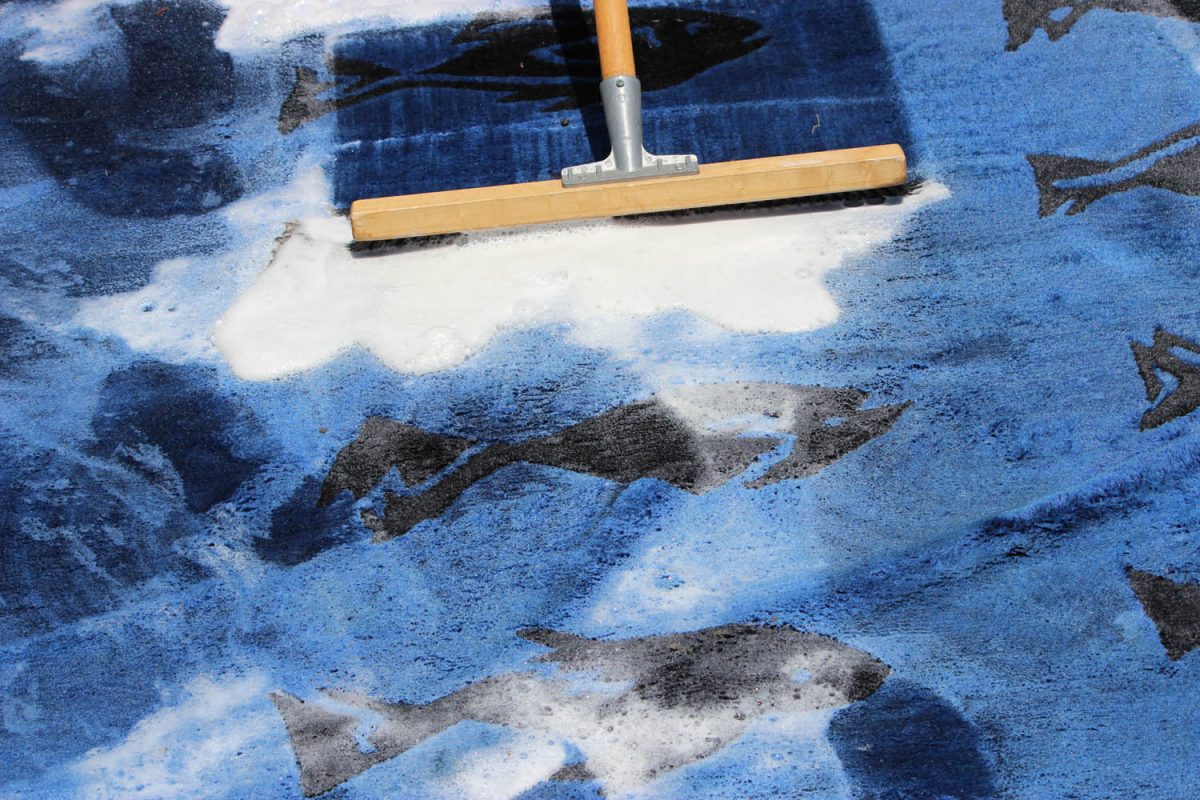
A soaked rug gets worse the longer it sits, so the first day matters more than any repair that follows. Get it lifted off wet flooring, stop the water spreading through the foundation, and get it to a facility for a full immersion wash and controlled drying.
A soaked rug gets worse the longer it sits. Whether the water came from a burst supply line under the kitchen sink, an overflowing planter, a failed water heater in the garage, or one of the winter storms that push runoff under a slab door, what you do in the first day matters more than any repair that comes later. We have been washing and rebuilding water-damaged rugs at our San Diego workshop since 1956, and the pattern is consistent: the rugs that recover fully are the ones that got lifted, drained, and dried correctly early. The permanent losses usually trace back to a well-meant home fix in the first 48 hours.
The first hour
- Lift the rug off the wet floor and out of any standing water.
- Roll it loosely instead of folding, so a dried-out foundation does not crack later.
- Blot the pile with clean towels to pull up as much water as you can.
- Keep it out of direct sun and away from the carpet machine.
- If furniture was sitting on the wet area, move it off. Wood stain and metal rust transfer into wet pile fast, and both are harder to remove than the water itself.
Move fast, ideally within 48 hours
Wool, cotton, and jute hold water like a sponge, and a wet rug left on a wet floor starts to smell and grow mildew within a couple of days. The floor matters as much as the rug. Most San Diego homes sit on concrete slab, and a slab that took water stays damp long after it looks dry, feeding moisture back into the rug from below. If the rug is safe to lift, get it up and let air reach both sides. If it is a large room-sized piece you cannot move alone, get help or call us before it sits another night.
Blot, do not rub or scrub
Press clean towels into the pile to lift the water out, working from the edges of the wet area toward the middle so you are not spreading it. Rubbing a wet rug drives grit deeper and can felt the wool, which is a texture change you cannot undo at home. Felting happens because each wool fiber is covered in microscopic scales, and heat plus moisture plus friction locks those scales together permanently. Leave the shop vac and the carpet machine for wall-to-wall carpet. They are not built for loose rugs with natural dyes and a cotton or silk foundation, and the suction can distort a hand-knotted pile that took decades to wear in evenly.
What the water was carrying matters
A clean supply-line break is the best case. Water from a drain, a toilet line, a fish tank, or street runoff carries bacteria and contaminants into the foundation, and a rug that took dirty water needs a full wash no matter how good it looks once dry. Planter overflow is its own category, and we see a lot of it here. Potting soil water carries tannins and fertilizer salts that leave a brown ring with a hard edge, and because the pot usually sat in one spot for months, the foundation underneath has often been cycling damp and dry long enough to weaken or rot. If a ceramic pot has been living on your rug, check under it today.
Why home drying often backfires
The instinct is to hang the rug over a railing in the sun and let the weather do the work. With a machine-made polyester rug that is sometimes fine. With wool, silk, or viscose it is risky. Direct sun fades natural dyes unevenly, and hanging a heavy wet rug stretches the weave while it dries, so the rug that comes off the railing may never lie flat again. Viscose especially turns brittle and yellow when it dries wrong, which is why water spots on a viscose rug almost always need a professional.
San Diego adds a complication people do not expect in a dry climate. From May into August the marine layer keeps overnight humidity high near the coast, and a rug hung out to dry in Point Loma or La Jolla can spend twelve hours a day reabsorbing moisture from the air. Drying has to be even and it has to finish. A rug that feels dry on top can still be damp in the foundation, and that trapped moisture is where odor and mildew start. Garages are the worst drying rooms in the county for the same reason: cool, unventilated, and sitting on slab.
How each fiber takes water
Wool is the most forgiving pile fiber. It can absorb around a third of its weight in water before it even feels saturated, and it usually survives a soaking if it dries evenly and reasonably fast. The cotton foundation inside most hand-knotted rugs is the weak point, since cotton holds water longer than wool and rots first. Silk keeps its strength when wet better than viscose but its dyes are delicate, so bleeding shows up sooner. Viscose loses most of its strength the moment it is saturated and can be permanently marked by plain water. Jute and other plant-fiber rugs brown quickly and are rarely worth wet-cleaning at all. Knowing what your rug is made of tells you how much time you have, and if you are not sure, treat it as delicate.
Two warning signs the damage runs deep
Watch for color running, where a red or navy begins to tint the lighter areas nearby. Once dyes migrate, reversing it is delicate work that depends on the fiber and the dye, and every hour the rug stays wet moves more color. The other sign is a musty smell that stays after the rug feels dry. That means moisture reached the backing, and it will not air out on its own. Mildew feeds on the cotton foundation, and by the time you can see grey or black spotting on the back of the rug, the fibers there have already lost strength.
When to call a professional
A small splash on a washable rug you can usually handle yourself. Bring in a professional when the rug is hand-knotted, antique, wool, silk, or viscose, when the water was dirty or came from a drain, when colors are bleeding, or when the smell will not leave. Those are the cases where a controlled wash and drying save the rug and a rushed home fix locks the damage in. If insurance is involved, get the rug assessed before anyone attempts a cleaning, since an adjuster wants to see the damage as it is.
How we handle a water-damaged rug
At Zeytounian Rugs a soaked rug comes into the workshop for our full immersion hand wash, the same nine step process three generations of our family have used, which flushes contaminants out of the foundation and stabilizes the dyes before anything else is attempted. The rug then dries flat under controlled moving air so the foundation dries all the way through without stretching. If the water loosened the ends or sides, our rug repair team re-secures the fringe and binding, and heavier cases move into full rug restoration. You can read more about the process on our water damage restoration page.
If your rug is wet right now, get it off the floor, start blotting, and call us at the shop. We answer questions about water damage every week, the estimate costs nothing, and if the rug is too heavy to move we pick up anywhere in San Diego County.
How Fast Water Damage Progresses, Hour by Hour
The reason we push so hard on the first day is that a wet rug does not stay in one condition. It moves through stages, and each one closes off options that were open in the stage before.
In the first hours the problem is purely water and whatever the water carried. The rug is heavy and saturated, but nothing irreversible has happened yet. Dyes are the immediate risk: a rug with unstable dyes can begin migrating colour from a dark field into an ivory ground while it is still soaked, and once red has moved into ivory it is a correction job, not a rinse. This is the window in which getting the rug off wet flooring and moving air across it does the most good.
Through the first day or two the concern shifts to what is growing. Mildew needs moisture, still air and time, and a thick rug lying flat on a damp floor provides all three at the foundation while the surface feels merely damp. Musty odor is the early signal. By the time it is noticeable the growth is established in the base of the weave, and no amount of surface drying reaches it.
Past that point the changes become structural. Cotton foundations that stay wet lose strength, which is the beginning of dry rot: the rug feels stiff, and the foundation cracks rather than flexes when you fold it. Wool that dries unevenly browns, as natural substances in the fiber wick to the surface and concentrate wherever the drying front stopped. Both are repairable, and both cost far more work than a prompt wash would have.
None of this is a reason to panic about a spilled glass of water. It is a reason to treat a genuinely soaked rug, from a supply line, a heater, an overflow or storm runoff, as time sensitive rather than as something to deal with after the floor is sorted out.
Frequently Asked Questions
Treat it as a matter of hours rather than days. Dye migration can begin while the rug is still saturated, and mildew becomes established at the foundation within a day or two of a rug lying wet. The rugs that recover fully are almost always the ones that were lifted and moved early.
No. Water from a supply line is a different problem from water that has run across a floor or come in from outside, because the second carries soil and contaminants into the foundation. Both need a full wash, but the second is a decontamination job as well as a drying job.
Because it was designed for wall to wall carpet glued to a subfloor. Running suction across a soaked handmade rug leaves salts, sediment and moisture buried in the base of the weave, and that buried dampness is where mildew and odor start.
It can, if it dries unevenly or with heat. Controlled drying under monitored airflow and humidity is what prevents shrinkage, browning and dye migration, and it is the part of the job that cannot be reproduced at home.
It means natural substances in the fiber have wicked to the surface and concentrated where the drying stopped. It is a sign the rug dried unevenly. It is correctable, but it needs to be addressed at the workshop rather than left.
Often it is. Dry rot weakens the cotton foundation so it cracks instead of flexing, and the repair is to rebuild the foundation and reknot the pile above it. Whether that is worth doing depends on the rug, and it is exactly the question a free evaluation answers.
It is worth having looked at, because the two things that matter most after a soaking are not visible from above. Mildew establishes at the foundation while the surface feels dry, and contaminants carried in by the water stay in the base of the weave. A rug that dried quickly and was only wetted with clean water is often genuinely fine, and the evaluation costs nothing.
