
Yes, you can spot clean an oriental rug, within limits, and our full guide to removing rug stains and odors at home covers the rest. Blotting a fresh spill and using a mild solution on a colorfast rug is usually safe. Scrubbing, heat, and store-bought carpet chemicals are how hand-knotted rugs get ruined. Here is where the safe line sits, and how San Diego’s climate moves it.
Why an Oriental Rug Reacts Differently Than Carpet
Oriental rug is a broad term for hand-knotted rugs from the traditional weaving regions, including Persia, Turkey, Afghanistan, Pakistan, India, China, and the Caucasus. A Turkish Oushak, an Afghan Kazak, and a flat-weave Kilim are all oriental rugs, and they all deserve the same care.
What they share is construction. Each one is thousands of individual knots tied by hand onto a woven foundation, usually wool or silk pile over cotton or wool warps. The colors come from natural or semi-natural dyes sitting on natural fiber. Wall-to-wall carpet is synthetic with factory-locked color, so products built for carpet can bleed dyes, shrink fibers, or break down the foundation of a hand-knotted rug.
Blot First, Always
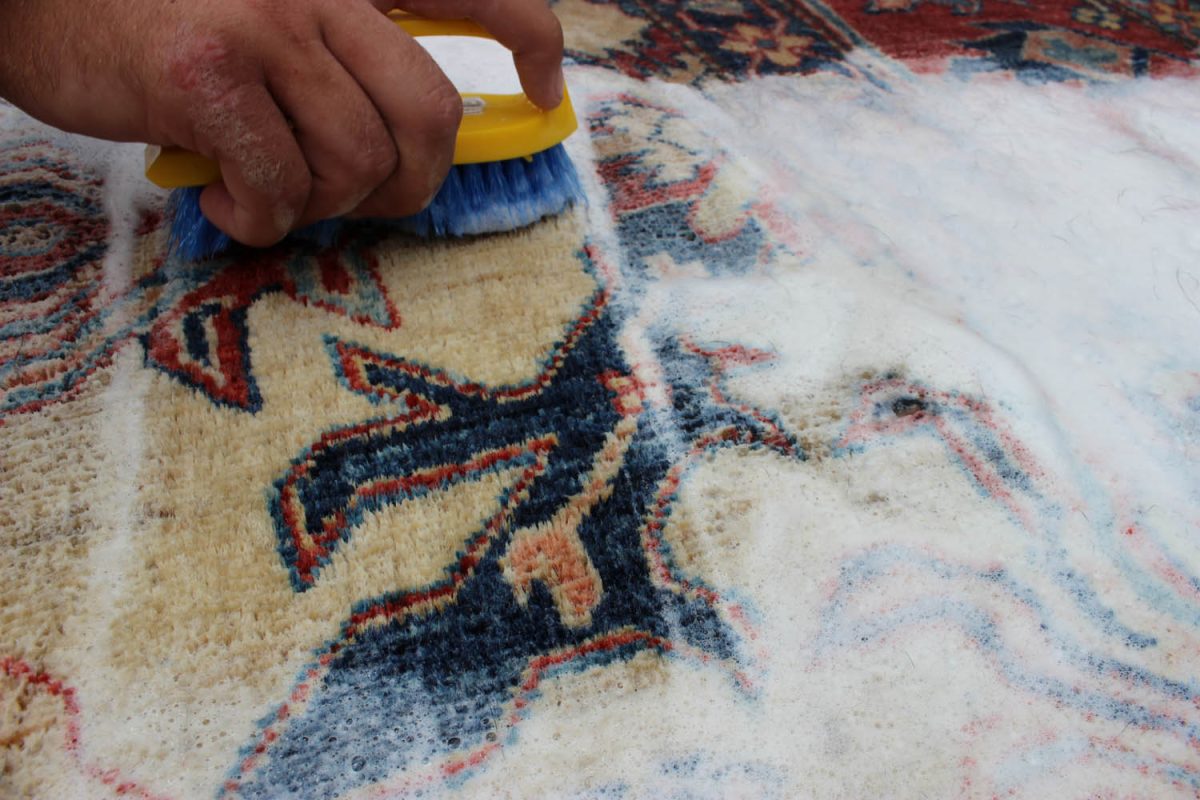
The moment something spills, grab a clean white cloth and blot. Press straight down and lift straight up. Rubbing or scrubbing drives the liquid deeper into the pile and can distort the fibers, while blotting pulls moisture up and out.
Work from the outer edge of the spill toward the center so you do not spread it. Keep going with fresh dry sections of cloth until nothing more transfers. For many everyday spills, careful blotting is the whole job, so do not reach for any solution until you have blotted fully.
If Blotting Is Not Enough
Mix cold water and white vinegar in equal parts with a few drops of plain dish soap. Before using it on the spill, dab a little on a hidden corner of the rug and press a white cloth against it. If any color transfers to the cloth, stop there, because the dyes are not colorfast and any liquid will make them run.
If the test comes back clean, apply a small amount to the spot and keep blotting. Two rules protect the rug through this whole process. Use cold water only, since heat can set stains and shrink wool. And use as little liquid as you can, because moisture that soaks into the foundation creates its own problems.
What Never to Touch an Oriental Rug
Most of the damage we see from home cleaning comes from products that are fine on synthetic carpet:
- Bleach and oxygen-based cleaners, which strip natural dyes and leave pale patches that cannot be fixed
- Steam cleaners, because heat plus deep moisture can shrink fibers, bleed colors, and mat wool pile permanently
- Carpet shampoo and foam, which leave residue in dense pile that attracts new dirt and makes the rug resoil faster
- Rubbing alcohol, which can shift natural dyes, especially on older and antique pieces
The safest mindset is to do the minimum. A stain that was blotted and left alone is an easy job for a wash facility. A stain that was scrubbed with the wrong chemical often becomes a permanent mark.
The Fiber Changes the Answer
Before you spot clean anything, know what your rug is made of. The same spill calls for different responses on different fibers.
Wool
Wool is the most forgiving fiber in the oriental rug world. Its natural lanolin gives it resilience and some resistance to soil, so careful blotting and a tested mild solution are usually safe. The vinegar solution above was made for wool rugs with stable dyes.
Silk
Silk fibers are very fine and their dyes are often delicate. Blot a spill dry and stop. Silk needs gentle low-pH washing with controlled moisture and no heat, and an aggressive home treatment can leave a mark worse than the original spill.
Viscose and Bamboo Silk
Plenty of rugs sold with a silky look are viscose or bamboo silk, and many custom designer pieces use them. These are cellulose fibers, and water alone can brown, stiffen, or distort them. Blot the spill dry and go no further, because even plain water spotting can leave a permanent mark on viscose.
Spills That Should Skip the DIY Stage
Some situations are beyond safe home treatment from the first minute, and pushing through them usually makes the repair bigger.
Pet urine is the most urgent. It soaks through the pile into the foundation and dries into salts, shifting from acidic to alkaline as it dries in a way that can permanently move dye colors. Those salts also pull in moisture from damp air and release odor again, which is why a spot that smelled fine flares up on a humid morning. Surface cleaning cannot reach them. The fix is a full pet urine and odor removal wash that dissolves the salts and flushes them out of the whole rug.
Red wine, coffee, and tea bond quickly to wool fibers as they dry. Blot immediately, then get the rug to a professional while the stain is fresh, because these are very treatable early and stubborn once set.
Wax and gum should never be scraped at home, since scraping can pull fibers out of the weave. And any large stain, or any stain you are unsure about, is a reason to stop and call before doing more.
Moth damage can look like a stain at first, a bare patch or gritty, sand-like residue where pile used to be. No spot treatment helps once larvae have eaten the wool, so stop and have rug moth damage repair in San Diego assess the area before anything else touches it.
Drying in San Diego Takes Longer Than You Think
After any spot cleaning, the rug has to dry completely, all the way through the foundation. Along the coast, from La Jolla to Coronado, the marine layer keeps air damp for much of the year, and that damp slows drying more than most people expect. A rug that stays wet inside can grow mildew deep in the pile before anything shows on the surface.
Lay the rug flat in a well-ventilated spot and let both sides dry fully before it goes back on the floor or under furniture. Keep it out of direct sun, which fades dyes, and never roll a rug up damp.
When Spot Cleaning Is the Wrong Tool
Spot cleaning treats one small area from the top. Soil, odor, and old spills live deeper, down in the foundation where the knots are tied. That deep material only comes out when the whole rug is submerged, washed by hand, and rinsed until the water runs clear, which is the process behind our oriental rug cleaning in San Diego.
If a spot resists a second gentle attempt, or dye shows on your cloth, or the rug is silk, viscose, or antique, stop there. Bringing the rug in at that point is a small job. Bringing it in after an aggressive home treatment often means repair work on top of cleaning.
Three Generations of Hand Washing in Kearny Mesa
Zeytounian Rug Cleaning & Repair has washed oriental and Persian rugs in San Diego since 1956. Every rug comes to our Kearny Mesa shop, where it is inspected, dye tested, and given a full immersion area rug washing suited to its fiber and construction. We have cleaned Turkish, Afghan, Persian, Pakistani, Chinese, and Indian pieces for three generations, and if a rug is hand-knotted, we know how to care for it.
We offer free estimates, plus pickup and delivery throughout San Diego County, and you can always drop a rug off at the shop. Call us at (858) 571-6808 if a spill has you unsure what to do next.
What a Set-In Stain Is Actually Doing to the Rug
Most advice about spills stops at the point where the mark stops being visible, which leaves out the part that matters for a rug you intend to keep.
A spill that has been blotted and left behind has not gone anywhere. What came out of the pile went down into the base of the knots, and the residue that stays there is chemically active in a way that a dry mark on a hard floor is not. Sugars and organic acids from food and drink stay slightly acidic against the wool and the dyes. Alkaline residues, from pet accidents or from many household cleaners, work in the opposite direction. Either way, the rug is sitting in a chemistry it was not woven for, and the fibers and dyes are in contact with it continuously.
There is a second effect that surprises people. Sticky residue at the base of the pile behaves like a soil magnet. The area attracts and holds dry dirt faster than the wool around it, which is why a spot that was cleaned up months ago slowly reappears as a dull grey patch even though nothing new has been spilled on it. The mark you are seeing is not the original stain returning. It is fresh soil sticking to what the original stain left behind.
The third is what happens to the dye. Given long enough, an alkaline residue can shift dye out of position, and unlike soil that is not something a wash reverses on its own. It becomes colour correction work at the bench.
None of that argues against blotting a fresh spill. Blotting immediately is still the single most useful thing anyone can do at home, and it genuinely saves rugs. The point is that blotting manages the emergency, and a wash is what finishes the job. If a rug has had several spills handled at home over a few years, the interval since its last real wash matters more than any one of those spots.
Frequently Asked Questions
Within limits, yes. Blotting a fresh spill immediately with a dry white towel is genuinely useful and saves rugs. What causes damage is what people do next: rubbing, applying heat, or reaching for a general purpose cleaner.
Anything containing bleach or peroxide, general purpose alkaline cleaners, hot water, and coloured towels that can transfer their own dye. Steam wands belong on wall to wall carpet, not on a handmade rug.
Because sticky residue left at the base of the pile attracts and holds dry soil faster than the wool around it. What you are seeing is fresh soil collecting on the old residue rather than the original stain returning.
Considerably. Wool tolerates careful blotting. Real silk needs a very light touch because it loses strength while wet. Viscose should barely be touched at all, since rubbing a damp viscose rug pulls fibers loose and leaves a permanent fuzzy patch.
Longer than most people expect, particularly near the coast where the marine layer keeps humidity high for months. A spot that feels dry on top can still be damp at the foundation, and that is where mildew and odor start.
As soon as blotting stops making a difference, and immediately for pet accidents, red wine, ink and anything on a silk or viscose rug. The estimate is free, so there is nothing lost in asking before trying one more thing.
A fan moving air across the area is fine and genuinely helps. A hair dryer is not, because it applies direct heat, and heat is one of the three conditions that felts and shrinks wool. On silk or viscose it can set a mark permanently. Keep the air moving and keep the heat away.
It does. Use a white or undyed towel, because a coloured one can transfer its own dye into a damp pile and leave you with a second problem on top of the first. Press firmly and lift rather than dragging, and swap to a dry section of towel as soon as the one you are using stops lifting liquid.
