

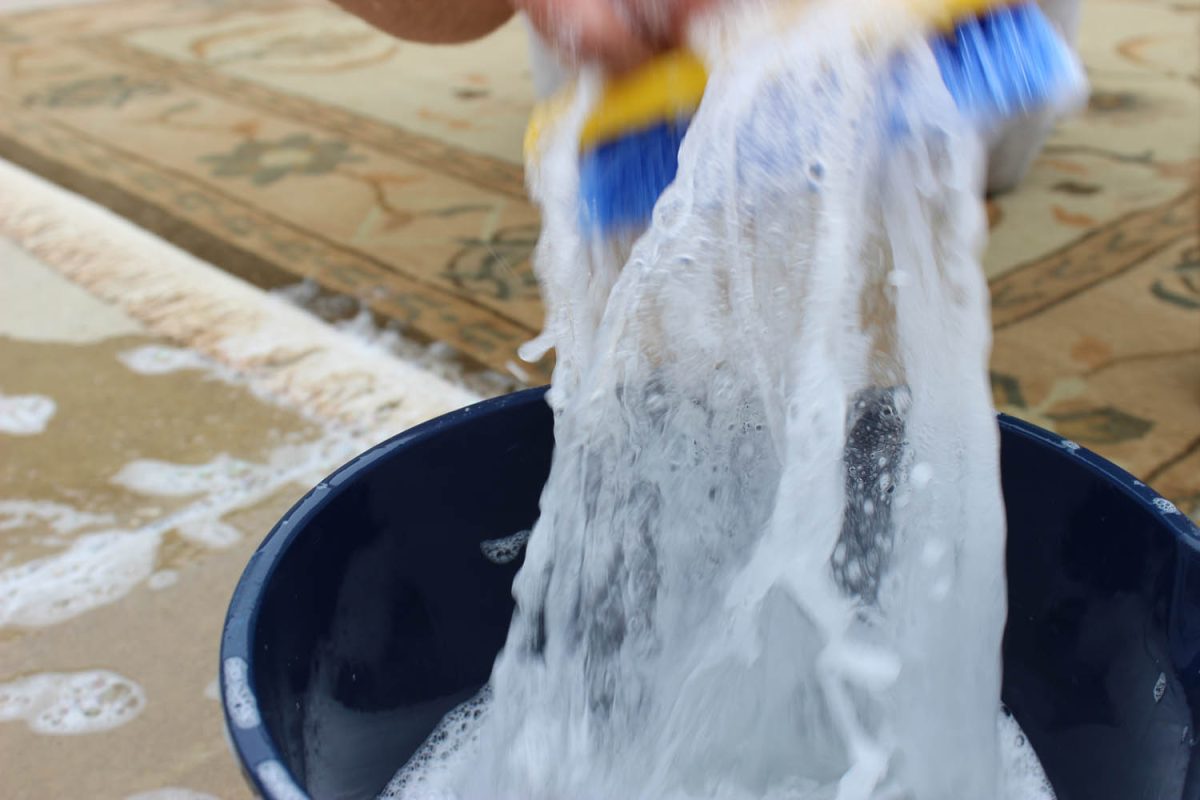
Surface cleaning treats only the top of the pile and leaves the foundation untouched. Full immersion washing puts the entire rug under water so the soil, salts, and grit trapped in the base are flushed out. For a handmade rug, only immersion actually cleans it.
When two shops both say they clean rugs, they may be doing very different things. One runs a machine over the surface in an hour. The other spends the better part of a week putting the rug through a full wash. The words sound the same in an ad, but the results are not close. Since 1956 our family has cleaned rugs the immersion way, and it is worth understanding exactly what that means and why the shortcut version leaves most of the dirt behind.
What surface cleaning actually reaches
Surface cleaning, whether it is dry compound, a light shampoo, or a pass with a hot water machine, works on the top layer of the pile. It can make a rug look brighter for a while by lifting the loose dirt you can see. What it does not do is reach the foundation. The grit, sand, salts, and fine soil that sift down to the base of the weave stay exactly where they are, because no amount of surface work pulls them up and out. On a synthetic carpet fixed to a floor, surface cleaning is often enough. On a handmade rug, it is half a job at best.
Where the real damage lives
The dirt that harms a rug is the dirt you cannot see. Hard grit packed into the foundation grinds against the fibers every time someone walks across the rug, cutting the wool at its base. Old moisture and organic soil down there feed odor and, in our coastal climate, clothes moths. A rug can look clean on top and be quietly failing underneath. Cleaning only the surface leaves every one of those problems in place, which is why a surface-cleaned rug so often smells or wears out anyway.
What full immersion washing does
Immersion washing takes the rug out of the equation entirely and treats it as the textile it is. The dry soil is beaten and shaken from the foundation first, then the whole rug goes under water for a hand wash with gentle, natural soaps, worked through the pile and the base until the water runs clean. Then comes the part that cannot be rushed: the rug dries flat in a controlled room where airflow and humidity are watched, so it dries evenly without browning or shrinking. Our nine step wash walks through each stage.
Why the drying matters as much as the washing
Getting a rug wet is easy. Getting it dry correctly is the skill. A rug that dries unevenly, in the sun, or with heat can brown, shrink, or bleed dye, and those are hard to undo. This is the single biggest reason a rug should never be cleaned in your living room and left to dry there. Controlled drying is a workshop process, and it is a large part of why immersion washing takes days rather than an hour.
How to tell which one a shop is really doing
Ask two questions. First, does the rug leave your home to be cleaned? A real immersion wash cannot happen on your floor, so if the whole job is done in your living room, it is surface cleaning. Second, how long will the rug be gone? An honest immersion wash takes one to two weeks because of the drying. If someone promises a fine rug back the same day, they are cleaning the surface and calling it a wash. The difference shows up on our page comparing washing and steam cleaning.
What a week in the wash actually looks like
Immersion washing takes days because each stage has to finish before the next begins. Compressed, the rug’s week runs like this.
It starts dry. The rug is evaluated, dyes are tested, and then it goes through dusting, where the sand and grit that sifted into the foundation over years get vibrated out before any water is involved. The pile on a neglected rug can hide pounds of dry soil, and washing it in would grind it against the fibers.
Into the water, then out of it
Then the rug goes under water. Fully submerged, washed by hand with soap matched to its fiber and dyes, and rinsed under running water until the water leaves clean. The submersion is the point: dissolved soil, salts, and residues leave the foundation because the water carries them out, not because a machine promised suction.
The centrifuge pulls roughly ninety percent of the water back out in minutes, which is what makes controlled drying possible. Then the rug lies flat in the drying room until it is dry through the foundation, gets groomed so the pile lies correctly, and passes a final inspection before it is rolled for pickup. The full detail lives on our nine step process page.
Where the shortcuts hide
Every quick version of rug cleaning is one of these stages skipped. No dusting means grit washed into the weave. No submersion means the foundation never got cleaned. No centrifuge means the rug dries slowly and browns. No drying room means it comes back damp in the middle. The stages are the product.
Problems only immersion can solve
Some conditions do not improve with any amount of surface work, because the problem is physically below where surface methods reach.
Pet odor is the clearest case. The deposits sit in the foundation, and humid mornings reactivate them year after year. Extended soaking dissolves them; nothing sprayed on the pile ever will. Salt is similar. Coastal homes load rugs with airborne salt that dulls dye, and inland homes contribute hard water residues from past cleanings. Both are soluble, and both leave the rug the first time it is genuinely submerged.
Fine dust is the sleeper. The powdery soil that works down into the base of the weave is what makes an old rug smell like an old rug and look tired even when the surface is vacuumed weekly. It comes out in the dust room and the rinse, which is why a first real wash on a decades old rug can feel like getting a different rug back.
The comparison in one place
| Question | Surface cleaning | Full immersion |
|---|---|---|
| Reaches the foundation | No | Yes, the whole rug is submerged |
| Removes dry grit first | No dusting stage | Yes, before water |
| Detergent left behind | Partial extraction | Rinsed until water runs clean |
| Pet odor at the base | Masked briefly | Dissolved and flushed |
| Salt and residue | Stays | Leaves with the wash water |
| Drying | Damp, on site | Centrifuged, then flat in a controlled room |
| Time | An hour | Days, on purpose |
Where surface methods honestly fit
Surface cleaning is not a scam. It is maintenance. A commercial space that wants a synthetic rug freshened quarterly, an installed carpet, a rug already on a regular immersion schedule that needs a touch up between washes: all reasonable. The failure mode is substitution, using the hour long method for years and believing the rug is clean because the surface is. The base keeps loading the whole time, and by the time the signs show, the rug needs more than a wash. If it has been years, or if there has ever been a pet incident, the honest starting point is immersion. After that, maintenance choices get much more forgiving.
What owners notice after a first real wash
People who have only ever had surface cleaning are consistently surprised by what comes back from immersion, and the surprises are worth naming because they are the honest evidence of the difference.
The colors read deeper. Not brighter in a chemical way, just true, because the gray film of fine soil that sat over every fiber is gone. Rugs are routinely mistaken for having been repaired or restored when all that happened is that years of grime left.
What you feel underfoot
The pile stands up. Grooming at the end of drying leaves the fibers aligned, and pile that had been matted flat by years of pressure and soil regains its height. The rug feels different underfoot, softer and more substantial at once.
The smell is neutral. Not perfumed, since fragrance is a mask and we do not use one. A properly washed and dried rug smells like clean wool, which after years of dusty or musty is its own kind of striking.
And the weight is honest. Owners sometimes notice the rug feels lighter, which is exactly the dry soil that used to live in the foundation, now gone down the wash floor drain.
Does immersion make sense for every rug
Almost every natural fiber rug, yes, and most synthetics too. The honest exception is economics: a machine made synthetic piece near the end of its life may not justify a full wash when replacement costs little more, and we will say so at evaluation rather than wash it and take the money. Delicate cases like viscose get a modified, more controlled version of the process, and genuinely fragile antiques are assessed piece by piece. What never changes is the principle that the foundation is where the dirt lives, and any method that cannot reach it is grooming, not cleaning.
Why the method has not changed since 1956
People sometimes ask why, after three generations, the process still looks the way it did when our family started. The honest answer is that the rugs have not changed. A hand knotted rug made this year is built the same way as one made a century ago, wool and cotton and dye in the same structure, and it responds to water, soil, and pressure the same way. The machines that transformed carpet cleaning were built for installed synthetic carpet, a product that did change. Nothing about them became more suitable for a wool foundation just because they got faster.
What has changed is at the edges: better soaps, better dye testing, a centrifuge instead of a mangle, climate control in the drying room. Each refinement serves the same underlying method, water carrying soil out of a submerged textile, because no shortcut has ever matched it. We keep the process because it keeps working, and the rugs that come back to us decades apart are the proof we get to see.
Common questions
For a light freshen-up between proper washes it has a place, but it does not clean the foundation, where the damaging grit and old soil sit. A handmade rug you care about needs periodic full immersion washing to actually be clean.
Usually one to two weeks. The washing itself is not the slow part. Controlled drying is, and rushing it is what causes browning and shrinkage, so a careful shop will not promise a fine rug back the same day.
No. It requires the rug to be fully submerged, hand washed, and dried flat in a controlled room. Any job done entirely on your living room floor is surface cleaning, not a wash.
Not when it is done correctly. Handmade rugs were made to be washed this way. We dye test first and match the wash to the fiber, and the controlled drying is what keeps the rug from browning or shrinking.
Because surface cleaning never reached the foundation, where old moisture and organic soil sit. Those come back as odor, especially in humid weather. A full wash that flushes the base is what clears it.
If your rug has only ever been surface cleaned, the foundation has never truly been washed. Request a free estimate and we will give it a full immersion wash at our San Diego workshop, with pickup and delivery countywide.
