
Pet urine smell keeps coming back because the part of the accident you can reach is only the surface. On a rug, urine soaks past the pile into the cotton foundation. Surface cleaning buys a week or two, and a full immersion wash is the only real fix.
You cleaned the spot twice. It smelled fine for a week, maybe two. Then a warm humid morning came through and the odor was back like nothing ever happened. Every dog and cat owner who brings a rug into our shop tells some version of this story, and the explanation is the same every time: the part of the accident you can reach is only the surface. On a rug, urine soaks past the pile into the cotton foundation, where it dries into crystalline salts and feeds bacteria that a surface spray never touches. Until those deposits leave the rug, the smell keeps coming home.
Why the smell comes back
Urine carries urea, salts, and uric acid. The urea and moisture dry off or rinse away, which is why a fresh cleanup seems to work. The uric acid crystallizes and bonds to the fibers deep in the rug, and crystals do not evaporate. When the air gets humid they reabsorb moisture and reactivate, releasing odor all over again, and the bacteria feeding on the deposit add their own smell on top. This is chemistry, and no amount of scrubbing the pile from above changes what is sitting in the foundation below it.
San Diego humidity makes it worse than people expect
Inland climates get a pass on this problem for most of the year. Coastal San Diego does not. The marine layer that rolls in from May through August keeps mornings damp from Ocean Beach to Del Mar, and even east of the 5 the overnight humidity is enough to wake up an old deposit. That is why so many people rediscover a pet spot in early summer, months after they thought they had dealt with it. If a rug in your house smells on grey mornings and fine by afternoon, that is uric acid answering the weather.
Act while it is fresh
- Blot up as much as you can with paper towels or a clean cloth, pressing down hard instead of wiping.
- Stand on the towels if you need to. Getting liquid out before it reaches the foundation is the whole game.
- Rinse the spot with cool water and blot again to dilute what soaked in.
- Keep the area ventilated so the pile can dry.
- Skip heat. A steam machine or hot water can set both the odor and the stain permanently.
What not to reach for
Ammonia-based cleaners are the classic mistake. Ammonia smells like urine to a pet, so you are marking the spot for a repeat visit, and it is harsh on wool and on natural dyes. Vinegar is gentler but still an acid bath for dyes that were never tested against it, and on a hand-knotted rug a color shift is a bigger problem than the odor was. Powdered carpet fresheners just perfume the pile while the deposit keeps working underneath. If you would not put a cleaner on a wool sweater you care about, do not put it on a wool rug.
Why home products fall short on rugs
Enzyme cleaners can help on a small fresh accident, and they are worth trying on a machine-washable rug. On a wool, silk, or antique rug they hit limits. The enzyme has to reach every crystal to work, which means saturating the foundation, and soaking a fine rug at home invites dye bleed, shrinkage, and a long wet time that grows mildew. Store carpet shampoos are built for synthetic wall-to-wall carpet. On the wrong rug they can strip color or leave a sticky residue that attracts more dirt, so the spot you treated turns grey over the next few months even though the accident is long gone.
What urine does to a rug over time
Odor is the symptom you notice. The damage underneath is quieter. Urine is alkaline when fresh and turns acidic as it breaks down, and that swing is hard on natural dyes, which is why an old pet spot often shows as a bleached or yellowed patch even after cleaning. On the cotton foundation, repeated wetting weakens the fibers the same way it does in water damage, and we regularly find brittle foundation under a favorite marking spot when a rug finally comes in. A rug that has taken years of accidents can need rug repair work in that area, not just a wash. The sooner the deposits come out, the less of this story plays out.
Finding the spots you cannot see
Rugs hide accidents well, especially busy traditional patterns, and cats in particular are discreet. If a room smells faintly on damp mornings and you cannot find the source, an inexpensive UV flashlight from the hardware store will show old urine deposits as a pale glow in a dark room. Check the back of the rug too, since urine travels down and spreads at the foundation, so the deposit on the underside is usually wider than the mark on top. When a rug arrives at our shop for odor work, the back tells us more than the front, and a spot the owner thought was the size of a coin often maps out to the size of a dinner plate underneath.
When a full wash is the real fix
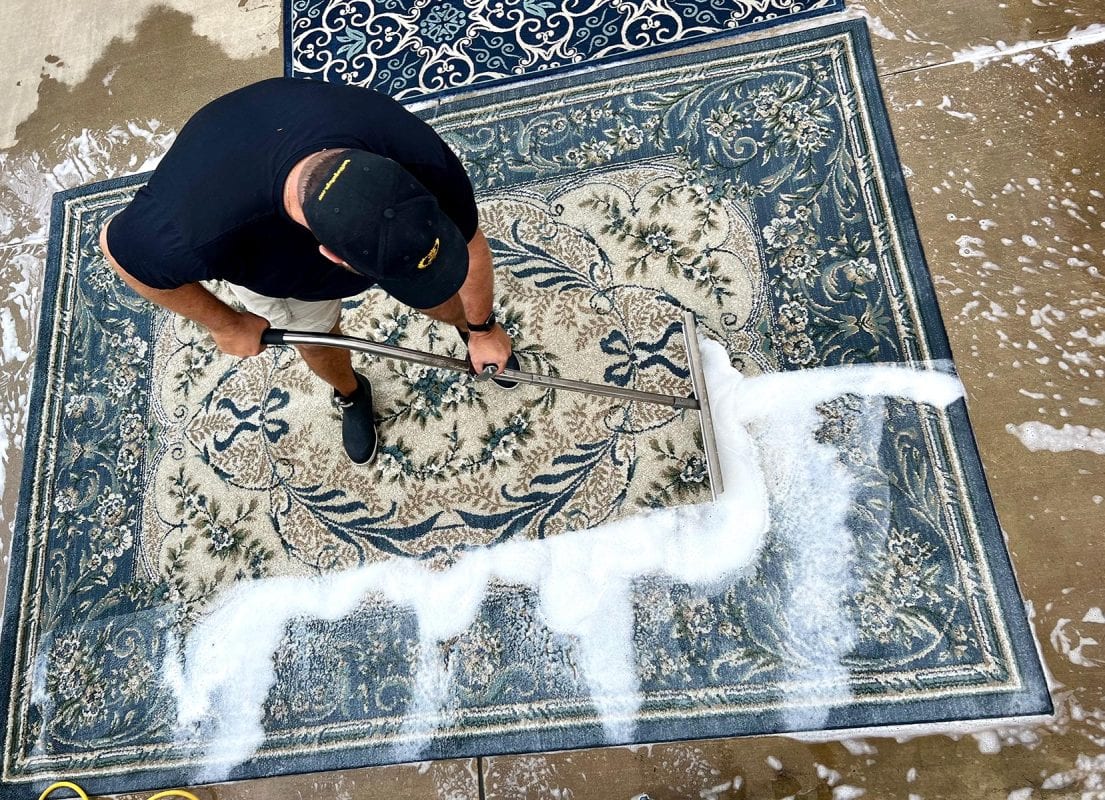
Set-in odor, repeat accidents in the same spot, or any accident on a hand-knotted or antique rug is a job for full immersion. Submerging the rug is the only way to dissolve the salts and rinse them out of the foundation instead of masking them at the surface, and it is the heart of the nine step wash our family has run since 1956. The rug soaks, the deposits dissolve, the wash water carries them away, and controlled flat drying makes sure nothing stays damp inside. Odor removal at the surface is temporary by definition. Removal at the foundation is done once.
If it keeps happening
Pets return to a spot they can still smell, even faintly, so a surface clean that leaves the deposit behind can turn one accident into a habit. Dogs and cats read a rug the way we read a sign. Getting the odor fully out removes the marker that draws them back, which is why a proper wash often ends the pattern entirely. If a rug has taken several accidents over time, have it washed sooner rather than later. The longer the deposits sit, the harder they are to rinse and the more they affect the dyes, and an older pet spot costs more to make right than a recent one.
How we treat a pet-urine rug
At Zeytounian Rugs, pet accidents are one of the most common reasons a rug comes through our door, and our answer is the full immersion hand wash: flush the salts and bacteria out of the foundation, neutralize what is left, then dry the rug flat under moving air so the foundation finishes bone dry. The full process is on our pet urine and odor removal page, and our rug washing page walks through the nine steps themselves.
You can drop your rug at our Kearny Mesa workshop on Ronson Road, or we will come get it. Pickup and delivery are available across San Diego County, the estimate is free, and our 5.0 rating on Google reviews includes a lot of pet owners who thought their rug was past saving.
Where the Urine Actually Sits, Layer by Layer
An accident on a rug is not one problem. It is three, stacked on top of each other, and home treatment usually solves only the first.
The top layer is the pile: the visible tips of the wool or silk you can see and touch. This is where a paper towel reaches, where a spray lands, and where a spot cleaner does its work. Clearing it removes the visible mark and a fraction of the smell, which is why home treatment feels like it worked. Almost none of the accident stays here, because liquid does not sit on a pile, it runs down it.
The middle layer is the base of the knots, where the pile is tied to the structure of the rug. Urine collects here and dries into a concentrated deposit of salts and organic residue. These deposits are hygroscopic, meaning they pull water back out of the air, which is the mechanism behind the single most common complaint we hear: the smell was gone for a week and came back on a humid morning. It never left. It simply needed moisture to become volatile again.
The bottom layer is the foundation itself, the cotton warp and weft the whole rug is built on, plus whatever backing sits beneath it. This is where damage rather than odor becomes the concern. Concentrated urine is alkaline and it stays in contact with dyes and cotton for as long as it is left there. Given enough time it moves dye out of position and weakens the cotton, and at that point the rug needs repair rather than cleaning.
A full immersion wash is the only approach that addresses all three layers at once, because the rug is submerged and water moves through the entire structure rather than across the top of it. That is the difference between removing an odor and covering one.
Frequently Asked Questions
The residue at the base of the knots is hygroscopic, meaning it pulls moisture out of the air. When humidity rises, that moisture reactivates the residue and the odor becomes volatile again. The smell was never removed, it was only dormant while the rug was dry.
Usually yes. Older accidents take a longer decontamination soak and there is more chance that dye has already moved, which is a separate correction. We tell you what we are seeing at the free estimate rather than after the fact.
They work better than perfumes, but they still have to reach the residue to act on it, and on a rug most of the residue is at the base of the knots and in the foundation where a surface application does not penetrate. On wall to wall carpet they have more of a chance.
No, and on a wool or handmade rug it can make things worse. Heat and agitation mat wool pile, and the machine only works the top of the pile in any case, so the deposits underneath stay where they are.
Often, yes. Urine passes through the rug, so the pad and sometimes the flooring underneath hold their own residue. A perfectly clean rug put back onto a contaminated floor will smell again.
Absorb as much as you can with dry white towels, pressing rather than rubbing, and keep going until the towels come up dry. Do not apply heat, do not scrub, and avoid general purpose cleaners and anything containing peroxide.
It changes the handling more than the principle. An older hand knotted rug with a thinning cotton foundation has less tolerance for a long soak, and its dyes are more likely to have already moved, so the decontamination is adjusted to what that specific rug can take. A large modern rug is more forgiving. Either way the accident has to come out of the foundation rather than off the surface.
Look at the back of the rug as well as the front, since old accidents often show as a stiff or discoloured patch on the foundation before anything is visible in the pile. Smell is the other guide, and it is strongest on a warm humid morning rather than on a dry afternoon. We map the affected areas at the estimate so nothing is missed in the wash.
