

There is no single price for oriental rug cleaning, because the work is priced by the rug in front of us, not by a flat rate. Size, fiber, condition, and any added treatment all move the number, which is why an honest estimate is free and given before any work starts.
People usually ask the price first, and we understand why. The trouble is that a hand knotted wool rug the size of a dining room and a small machine made runner from a hallway are two completely different jobs, and quoting them the same would be dishonest. What we can do is explain exactly what moves the cost, so you know what you are paying for before you ever hand over the rug. Our family has washed rugs at the same San Diego workshop since 1956, and the estimate is always free, in writing, and given before we start.
Why nobody can quote a real price over the phone
A responsible shop will not give you a firm number sight unseen, and a shop that does is guessing. Two rugs that look the same size can need very different work. One might be a sturdy wool piece that only needs a wash, and the other a silk rug with a set-in stain, a torn edge, and a corner the dog got to. The second rug is hours more work. When someone quotes a flat rate before seeing the rug, they are either padding the price to cover the worst case or planning to add charges once your rug is already in their van.
We look at the rug first, tell you what it needs, and put the number in writing. If it needs less than you feared, the estimate says so.
Size is the starting point, but not the whole story
Rugs are measured by the square foot, and a larger rug takes more water, more bench time, and more drying space, so size is where any estimate begins. It is only the starting point, though. A large but simple wool rug in good shape can be more straightforward than a small antique silk piece that needs careful dye testing and hand finishing. Think of the size as the base, and the next few factors as what adjusts it up or down.
Fiber changes everything
What the rug is made of is the biggest single factor after size. Sturdy wool is the most forgiving to wash. Silk and the plant-based fibers are slower and more delicate, and they carry more risk, so they take more care and more time. If you are not sure what you have, our guide on silk rug cleaning and viscose rug cleaning explains why those two need such different handling from a standard wool rug.
- Wool handles a full immersion wash well and is the most common rug we see.
- Silk is delicate, holds dye differently, and needs slow, controlled work.
- Viscose and bamboo silk are plant fibers that look like silk but behave nothing like it, and they need the gentlest wash on the bench.
- Hand knotted versus machine made matters too, because a hand knotted rug is worth the extra care and a machine made rug usually is not treated the same way.
Condition and what the rug has been through
A rug that has been cleaned every few years and stored well is a quick job. A rug that has never been washed in decades, or that came in after a flood, a pet problem, or years under a heavy couch, needs more. Set-in pet urine calls for a decontamination treatment that breaks down the salts at the source. Water damage needs controlled drying so the rug does not brown or shrink, which we cover on our water damage restoration page. Moth grazing or a worn edge crosses over into repair and reweaving, which is priced separately from the wash because it is separate work.
What does not cost extra
The estimate is always free, and we offer pickup and delivery across San Diego County. We collect the rug, evaluate it at the workshop, and tell you the number before we begin. If you decide not to go ahead, we bring the rug back and you owe nothing.
How to get a real number for your rug
The only accurate estimate is one made with your actual rug on the bench. We unroll it, check the fiber and the foundation, look for damage that a wash alone will not fix, and write it all down. Because the estimate costs nothing, there is no reason to guess from a phone quote. A rug that looks alarming often needs less than you expect, and one that looks fine can be hiding foundation damage that a proper look catches early.
What a written estimate actually includes
An estimate from our workshop is not a number scribbled on a card. It is the result of a physical evaluation, and it commits us to a scope of work in writing before you decide anything.
The evaluation starts with fiber. We confirm what the rug is actually made of, because plenty of rugs sold as silk are viscose and a fair number of machine made pieces pass for hand knotted at a glance. Then we test the dyes in an inconspicuous spot to see how they behave with moisture, check the foundation for dry rot by flexing the back and listening for the telltale crackle, and map the condition: worn areas, stains, pet spots, loose edges, fringe damage, old repairs. Everything we find goes on the written sheet, along with what we recommend doing about it and what we recommend leaving alone.
That last part surprises people. Not every flaw is worth fixing, and an honest evaluation says so. A stable old repair on the back of a rug that lies flat can often stay exactly where it is.
Why writing it down protects you
A written scope means the price cannot drift once the rug is out of your sight. If we open a rug on the wash floor and find something the evaluation could not see, we call you before doing anything about it. You approve the change or you decline it. The alternative, common in this trade, is a vague verbal quote that grows quietly between drop off and pickup. The paper is your protection, and frankly it is ours too.
Where the work actually goes
People assume the cost of rug cleaning is mostly soap and water. It is almost entirely skilled time, and understanding where that time goes explains why two similar looking rugs can need very different amounts of it.
Dusting comes first and it is the step that varies most. A rug from a home near the beach can hold a startling amount of fine sand in its foundation, and every bit of it has to come out dry, before the rug ever touches water. Wet sand turns to grinding paste inside the weave. A rug that has gone many years without a wash can take several passes on the dusting equipment where a regularly maintained one needs a single pass.
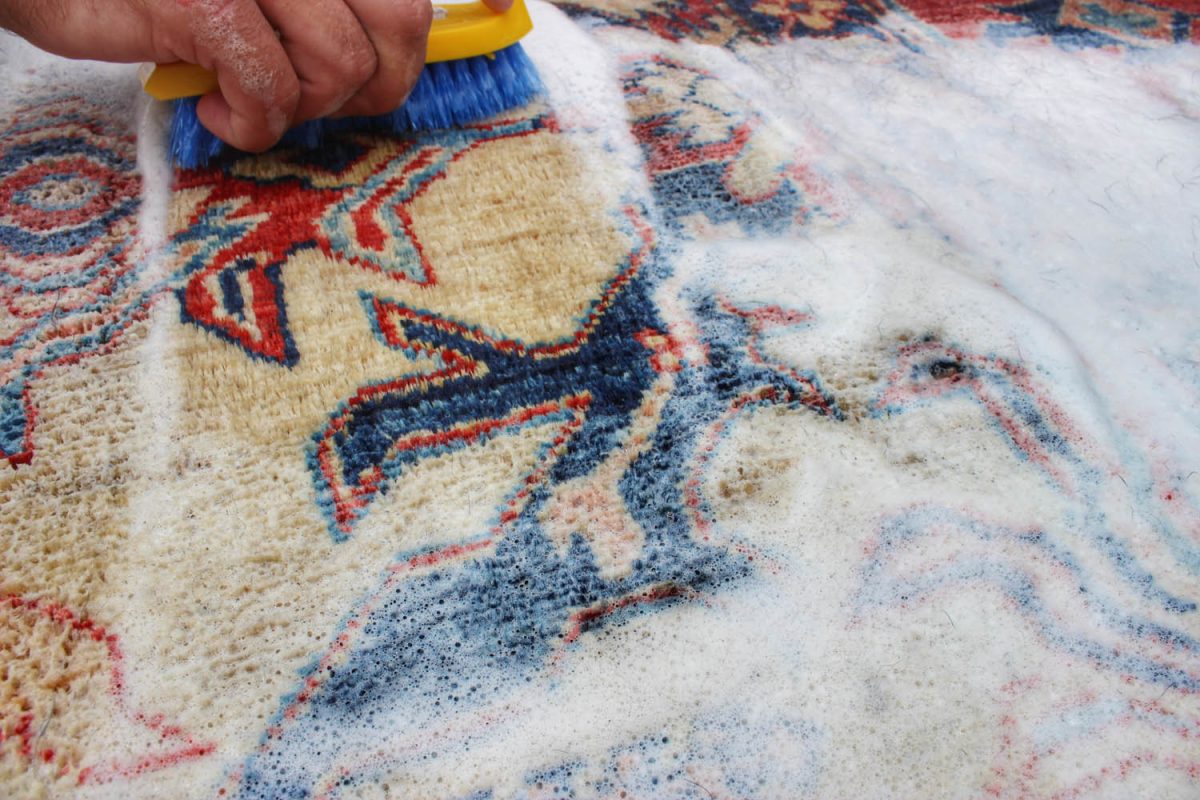
The wash itself is careful hand work with tools and soaps chosen for that specific fiber and those specific dyes. Then comes controlled drying, the slow part that a rushed shop skips. Our nine step immersion process walks through each stage in detail.
Treatments that add time
Some rugs need more than the standard wash, and these are the additions the estimate will name specifically:
- Pet urine decontamination. Urine that has reached the foundation needs its own extended soak to dissolve the crystallized deposits. It roughly doubles the water time for the affected rug.
- Moth treatment. Eggs and larvae have to be fully cleared, and the damaged pile assessed for repair, which is separate hand work.
- Color run correction. If old dyes have bled from a past incident, correcting it is delicate, slow work that not every rug can tolerate.
- Repairs. Fringe, edges, and reweaving happen before the wash and are always quoted as their own line, never buried in the cleaning.
Each of these appears on the written estimate as its own item, so you can see what the rug needs versus what you might choose to defer.
Questions worth asking any rug shop
Whoever you call, a few direct questions will tell you quickly whether you are dealing with a rug washing facility or a carpet company with a van.
Ask where the work happens. If the answer is your living room, it is surface cleaning, whatever the ad said. Ask what happens to the fringe, because fringe on a hand knotted rug is the exposed end of the foundation itself and bleach scrubbing it is a repair bill waiting to happen. Ask whether they test dyes before washing. Ask how the rug is dried and how long that takes, since a same day turnaround means the drying was forced. And ask whether the estimate is free, written, and given before work starts.
A good shop answers all of this without hesitation. We have been answering these questions at the same Kearny Mesa workshop for three generations, and we would far rather you ask them than drop off a rug with doubts.
Drop off or pickup, the estimate works the same
Some owners like to bring the rug to the workshop and watch the evaluation happen, and we enjoy those visits. You see the wash floor, we look at the rug together, and the written estimate is in your hand before you leave. Others prefer that we collect the rug, in which case the evaluation happens when it arrives and the estimate reaches you by phone or email for approval before anything begins. Pickup and delivery can be scheduled with a call.
Either way, the rule does not bend: no work starts until you have the written scope and have said yes to it. A rug sitting in our racks awaiting approval costs you nothing.
Comparing estimates between shops
If you collect more than one estimate, compare the scopes before the numbers. A cheaper quote that never mentions dusting, dye testing, or controlled drying is not a lower price for the same work. It is a different, smaller job wearing the same name. Line the written scopes up side by side and ask each shop what happens at every stage. The estimate that survives that conversation intact is usually the honest one, whatever it says at the bottom.
Common questions
We can talk through what your rug likely needs and what will affect the cost, but we do not give a firm number until we have seen the rug. A phone quote on a rug nobody has looked at is a guess, and guesses are usually padded. The in-person estimate is free.
Yes. We pick the rug up, evaluate it, and give you the number in writing. If you decide not to proceed, we return the rug and you owe nothing.
Larger rugs take more water, bench time, and drying space, so size is the base of any estimate. It is not the whole picture, though. A large simple wool rug can be a lighter job than a small delicate silk piece that needs dye testing and hand finishing.
Silk is delicate, holds its dyes differently, and carries more risk in the wash, so it is slower and more careful work. Wool is sturdier and more forgiving, which is why the two are not priced the same.
Yes, because repair is separate work. A wash cleans the rug; reweaving a moth-eaten patch or rebuilding a worn edge is a different job done by hand, and it is quoted on its own so you can decide what you want done.
If you want a real number for your rug rather than a phone guess, request a free estimate. We collect it, evaluate it at our Kearny Mesa workshop, and put the cost in writing before any work begins, and the estimate is free.
