You can usually tell wool, silk, and viscose apart with three quick checks at home: how the rug feels, how the fibers look up close, and how a few loose strands react to a careful burn test. Each fiber needs different care, so knowing which you have matters before anyone cleans it.
Fiber is the first thing we check on any rug that comes into the workshop, because it decides everything that follows. Wool, silk, and viscose can look alike in a room, especially under lamplight, but they behave nothing alike in water. Get it wrong and a rug that should have been washed gently gets treated like a sturdy wool piece, or worse. You can make a good first guess at home with a few simple checks, and here is how we do it after handling rugs since 1956.
Start with how it feels and how it wears
Wool has a slight spring to it. Press your palm into the pile and it pushes back, and it feels warm and a little dry. Silk is cool, smooth, and dense, with a fine pile that feels almost liquid under your hand. Viscose, which is a plant based fiber made to imitate silk, feels soft and slippery when new but often shows its true nature in wear, going flat, matted, or slightly fuzzy in the traffic paths where real silk would hold up. A rug that looks like silk but has gone dull and stringy in the walkways is very often viscose.
Look at the sheen and the color
Silk has a deep sheen that changes as you move around it, brightening from one angle and darkening from another. Viscose has a sheen too, but it is flatter and more uniform, a shine that looks the same from most angles. Wool has the least sheen of the three, a soft matte look. Color is another clue. Real silk and good wool hold rich, stable color, while viscose can look slightly harsh or plasticky in bright light and is the fiber most likely to have browned or yellowed if it has ever gotten damp.
The fringe tells you a lot
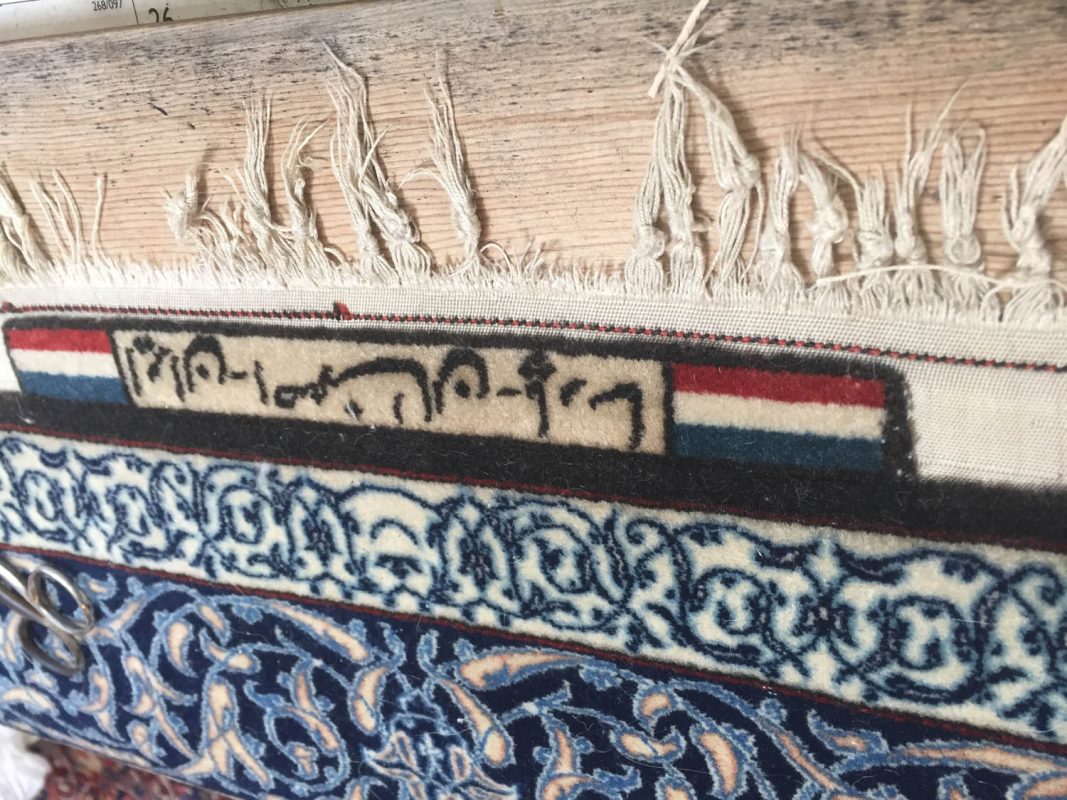
On a hand knotted rug the fringe is not sewn on, it is the actual foundation of the rug showing at the ends. Look at what that fringe is made of. A cotton or wool foundation points to a genuine handmade wool or silk rug. If the fringe looks glued or stitched on as a separate strip, you are likely holding a machine made rug, and machine made silk-look rugs are usually viscose or another synthetic.
The burn test, done carefully
This is the check that settles it, and it is safe if you do it with a few loose strands over a sink, never on the rug body. Snip or pull two or three loose fibers from the back or the fringe and hold them to a flame with tweezers.
- Wool smells like burnt hair, curls away from the flame, self extinguishes, and leaves a brittle ash you can crush to powder.
- Silk also smells like burnt hair but burns slower, leaving a small crushable bead of ash.
- Viscose smells like burning paper, because it is plant cellulose, and it burns fast with a soft gray ash.
The paper smell is the giveaway. Wool and silk are protein fibers and smell like hair. Viscose is wood pulp and smells like a campfire log.
Why the difference decides the cleaning
Once you know the fiber, the right care is clear. A wool rug handles a full immersion wash well. Silk needs slow, gentle, controlled work because of how it holds dye and moisture. Viscose is the fragile one. It loses strength when wet, browns easily, and can be ruined by the same treatment that would clean wool without a problem. This is exactly why we test fiber before water ever touches a rug.
When to just let us check
If you are still not sure, that is normal. Blends exist, and a rug can be wool pile on a cotton foundation with a silk highlight, which is common in fine oriental rugs. We identify the fiber as part of every free estimate, so if the home checks leave you guessing, the safest move is to let us look before anyone cleans it.
The tricky cases that fool everyone
The three way test works when a rug is honestly one fiber. Plenty are not, and the mixed cases are where owners get burned.
Wool rugs with silk highlights are common in finer Persian and Turkish weaving. The field is wool, but flowers, outlines, or small details are knotted in real silk that catches the light. Run your fingers across the pattern and feel for patches that are cooler and slicker than their surroundings. A rug like this has to be cleaned to the standard of its most delicate fiber, which is the silk, even though it is nearly all wool.
The imposters by name
Mercerized cotton is the old imposter. Treated to take on a silky luster, it shows up in rugs sold decades ago as art silk, and the name stuck. It burns like paper, smells like burning leaves rather than hair, and goes limp when damp. Viscose is the modern version of the same trick with a newer name on the tag.
And the tag itself deserves suspicion. Labels fall off, sellers repeat what they were told, and bamboo silk, banana silk, and Tencel are all cellulose fibers wearing silk’s name. If the price was too good for real silk, it almost certainly was not real silk.
The foundation tells its own story
Flip a corner and look at the warp threads the fringe grows out of. Cotton foundation is the workhorse of most hand knotted rugs and feels like kitchen string. A silk foundation, fine and lustrous even on the back, marks a genuinely fine piece that should only ever be hand washed. Jute foundation, coarse and fibrous like rope, turns up in many machine made and flat woven pieces and hates water, which changes the wash plan entirely.
One glance reference
| Check | Wool | Silk | Viscose |
|---|---|---|---|
| Hand feel | Warm, springy, pushes back | Cool, dense, liquid smooth | Soft and slippery, no body |
| Sheen | Low, matte | Deep, shifts with angle | Flat shine, same from all angles |
| Traffic paths | Holds up for decades | Wears slowly, keeps luster | Mats, fuzzes, goes stringy |
| Burn test strand | Smells like burnt hair, crushable ash | Also hair smell, fine ash | Smells like burning paper, ash curls |
| Wet behavior | Strong, forgiving | Delicate, needs cool water | Loses most strength, browns easily |
Print it, or just remember the shorthand: hair smell means protein fiber, paper smell means plant fiber, and plant fiber pretending to be silk is the rug to worry about.
What your answer changes at home
Fiber decides more than the professional wash. It sets the rules for everything you do between washes.
Wool forgives. Vacuum it with suction only, no beater bar chewing the pile, blot spills promptly, and it will shrug off years of normal life. Its lanolin content sheds light soiling, which is why a wool rug can look respectable long after it is genuinely dirty at the base.
The delicate two
Silk wants distance from water and from heat. Blot a spill with a dry white cloth and stop there. No home spotters, no hair dryer, nothing hot. The fiber is strong dry and vulnerable wet, and shiny water marks on silk are usually permanent souvenirs of home treatment.
Viscose demands the most caution precisely because it is the cheapest. Even plain water can leave a permanent yellow ring, so the honest home care advice is dry methods only and a professional call the moment liquid is involved. Our viscose cleaning page explains why so many shops refuse the fiber outright.
When the test still is not sure
Some rugs resist every home check. Tight city weaves, chemically washed pieces, blends layered over unusual foundations. Bring one of those by the workshop and identifying it takes us a minute at no charge, because we would genuinely rather identify a fiber before a wash than repair a misidentified one after. It is the difference between a question and a repair job, and we have seen the second version often enough.
Dyes and age tell you almost as much
Fiber is the first identity question, but the dyes running through it carry their own information, and reading both together is how a rug gets placed properly.
Abrash, the subtle banding where a color shifts tone across the field, is the signature of yarn dyed in small batches, usually by hand. It reads as a flaw to first time owners and as authenticity to everyone else. Perfectly uniform color across a large rug points to modern synthetic dyeing, which is not a fault, just a fact about the rug’s origin and age.
Reading age honestly
Age shows in gentler ways: colors softened evenly across decades, a pile worn low but consistently, a back whose knots have polished slightly with years of floor contact. An old rug in honest condition is a different object from a new rug distressed to look old, and the two should not be cleaned identically. The older the piece, the more the dye testing before washing matters, since early synthetic dyes from certain eras are famously unstable in water.
None of this changes the home care rules, but it changes what we do at the workshop, and it is a fair part of why the evaluation happens before the estimate.
Handmade or machine made, settled from the back
One more check belongs in the kit because it changes the stakes of everything above. Flip the rug over. On a hand knotted piece the pattern is clearly visible on the back, drawn in the knots themselves, and small irregularities in the rows are normal. A machine made rug shows a uniform mesh, often with latex or glue holding the backing, and the pattern on the back looks faded or blurry rather than knotted. Fringe that is sewn on as a strip rather than emerging from the rug’s own foundation is another machine tell. Handmade raises the care standard for every fiber on this page; machine made relaxes it.
Common questions
Yes, if you only use two or three loose strands pulled from the back or fringe and hold them over a sink with tweezers. Never hold a flame to the body of the rug. The test on loose fibers tells you protein from plant fiber quickly and safely.
Feel and wear are the fast checks. Real silk is cool with a sheen that shifts as you move, and it holds up in traffic paths. Viscose feels slippery when new but goes flat, matted, or fuzzy in the walkways, and its shine is flatter. A burn test confirms it, since viscose smells like burning paper.
Because each one needs a different wash. Wool tolerates a full immersion clean, silk needs slow careful handling, and viscose loses strength when wet and browns easily. The wrong method for the fiber is how rugs get damaged.
Almost certainly viscose. Real silk keeps its body and sheen in traffic areas, while viscose crushes and dulls quickly where people walk. It is the most common reason a shiny rug looks worn out within a couple of years.
Yes, and many good ones are. A fine oriental rug might have a wool pile on a cotton foundation with silk used for highlights. We identify all of it during the free estimate so the rug is cleaned correctly.
Not sure what your rug is made of? We identify the fiber on every rug as part of a free estimate, before any cleaning is decided. Ask us to take a look, with pickup and delivery across San Diego County.
